I used to roll my eyes at people who talked about manifesting on the new moon. The word itself carried too much baggage. Influencers writing dream-home descriptions in pink pen on full-moon paper. Vision boards covered in stock images of luxury cars and rose petals. The whole industry around "manifesting your dream life" felt like wishful thinking dressed up in mystical language.
Then I started using the new moon to write down three things I wanted to take seriously for the next six months. I did it as an experiment, not a ritual. Six months later, I read what I had written. Some of it had happened. Some of it had not. The pattern was useful. The things I had committed to with specificity and small daily actions had moved forward. The things I had written as vague wishes had stayed exactly where they were.
That is when I understood what new moon manifestation really does. The word "manifest" misleads people. The practice itself is something much simpler, much older, and much more useful than the woo-woo packaging suggests.
This post is about why the new moon is the right time to do it, what the practice does to your brain, how the lunar cycle gives you a built-in feedback loop, and how Cosmicarta's synthesis approach uses all three systems (astrology, Human Design, and numerology) to make new moon intentions specific to your chart rather than generic to the calendar.
TL;DR
The new moon is the moment when the Sun and Moon are conjunct in the sky. It marks the start of a new lunar cycle of approximately 29.5 days. Setting intentions at the new moon is a tradition found in cultures from ancient Mesopotamia to modern psychology. The practical reason it works is that the lunar cycle gives you a natural review timer. Six months after any new moon, the corresponding full moon falls in the opposite sign of the zodiac, marking a culmination point. Whatever you commit to at a new moon, you have an automatic review date built into the calendar.
The practice itself is structured intention setting with a celestial anchor. Write down what you want to take seriously. Make it specific. Review it at the corresponding full moon six months later. Notice what held up. Notice what did not.
What the new moon is
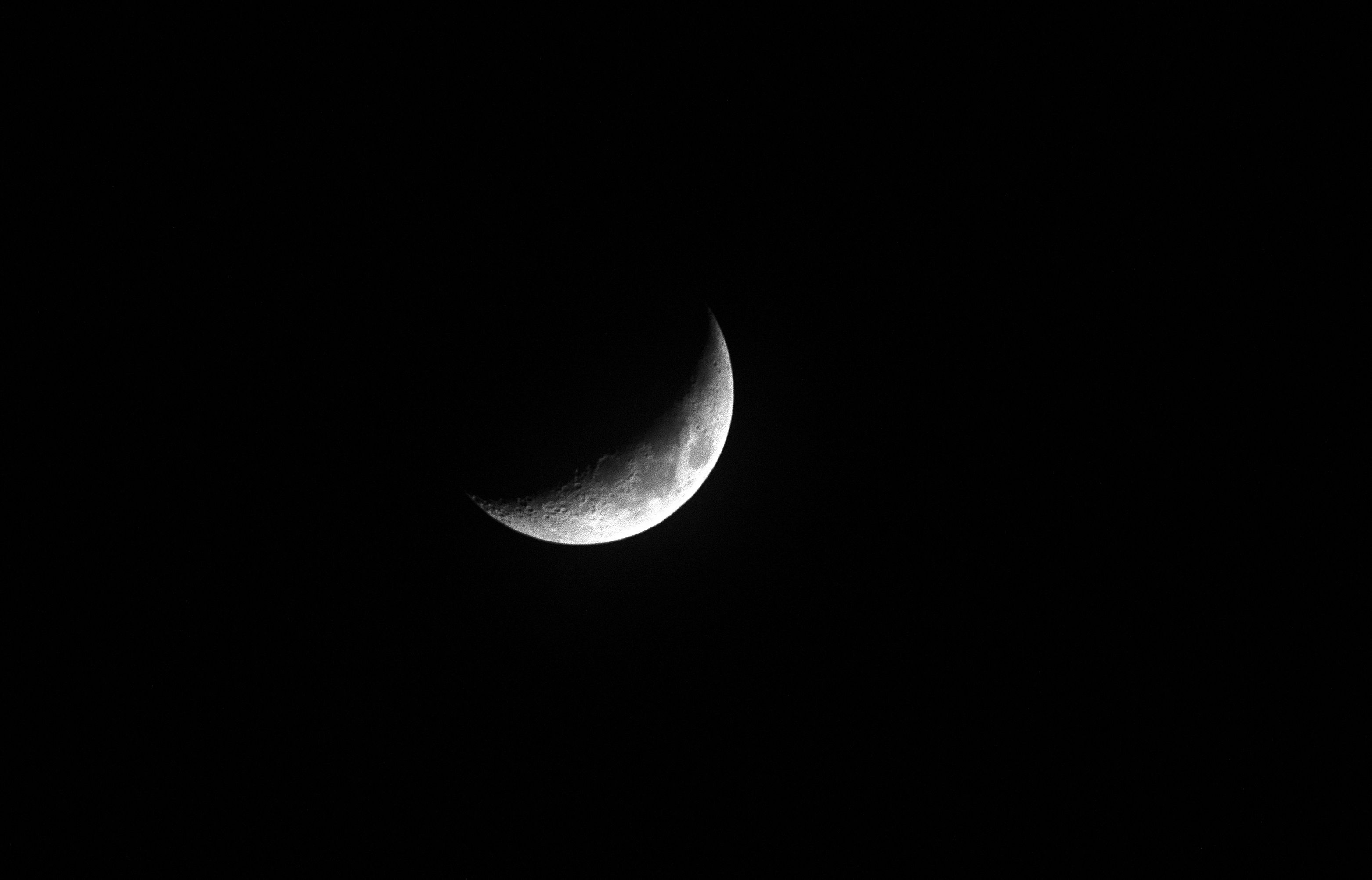
A new moon happens when the Moon passes between the Earth and the Sun. The lit side of the Moon faces away from us. The Moon is invisible to the naked eye. Astronomically, it marks the start of a new synodic month.
The synodic month is approximately 29.53 days long. This is the cycle of phases we observe from Earth: new moon, waxing crescent, first quarter, waxing gibbous, full moon, waning gibbous, last quarter, waning crescent, back to new. According to NASA, this cycle has been observed and tracked by humans for at least 30,000 years, evidenced by lunar tally marks found on bone fragments in archaeological sites.
The new moon is the most ambiguous phase to observe because there is nothing to see. The Moon is in the sky during daylight hours, but it is invisible. This invisibility is part of what gave the new moon its symbolic significance across cultures. It represents the moment before becoming. The seed before the sprout. The silence before the word.
Why people have set intentions at the new moon for thousands of years
The tradition of marking the new moon as a time for new beginnings is one of the most cross-cultural practices in human history. Babylonian astrologers tracked the new moon for ritual and calendar purposes. The Hebrew calendar begins each month at the new moon (Rosh Chodesh). Islamic months begin at the sighting of the new crescent. Chinese, Vietnamese, and Korean traditional calendars are lunisolar and tie significant events to the new moon. Hindu Panchang astrology assigns special weight to new moon days (Amavasya).
None of these traditions were doing "manifestation" in the modern sense. They were doing something simpler: marking time, setting agricultural and religious priorities, recognising a natural transition point. The modern Western practice of new moon intention setting is a continuation of this tradition, repackaged through the language of personal development and astrology.
The reason the practice survived for millennia is that the lunar cycle is one of the few rhythms in human life that runs on a timescale we can act on. A year is too long to feel the closure of any single intention. A week is too short to give an intention time to develop. A lunar month is about right. Twenty-nine days is enough time for an intention to either take root or reveal itself as something you never wanted.
What it does to your brain
There is a real psychological mechanism behind why writing down intentions works, independent of any astrological framework.
A 2015 study by Dr Gail Matthews at Dominican University of California found that participants who wrote down their goals were 42% more likely to achieve them than participants who only thought about them. The study also found that participants who shared their written goals with a friend and sent weekly progress updates were more successful again.
The mechanism is straightforward. Writing turns vague intentions into specific commitments. Specific commitments are easier to act on than vague wishes. Acting on commitments builds momentum. Reviewing them at fixed intervals provides feedback that either strengthens the commitment or surfaces that it was never the right goal.
The new moon adds two things to this mechanism that ordinary goal setting does not have. It adds a memorable anchor (you remember the cosmic event better than you remember a random Tuesday) and it adds a built-in review date (the corresponding full moon falls in the opposite sign six months later).
In other words, the new moon is a mnemonic device dressed up in symbolism. The symbolism makes the practice memorable. The astronomical regularity makes the practice repeatable. The two together turn intention setting from a one-off into a recurring habit.
The six-month full moon review
Here is the part most "manifest your dream life" content leaves out.
Every new moon has a corresponding full moon six months later in the opposite sign of the zodiac. A new moon in Gemini (where the Sun and Moon are both in Gemini) is followed approximately six months later by a full moon in Gemini (where the Moon is back in Gemini but the Sun has moved to Sagittarius). This is a structural feature of the zodiac, not a mystical claim. The Sun moves through the zodiac at approximately 30 degrees per month. Six months later, the Sun has moved roughly 180 degrees, and the full moon lights up the same sign you set intentions in.
What this means practically: any intention you set at a new moon has an automatic six-month review date built into the calendar. You do not have to remember to follow up. The astronomical event reminds you.
For the 15 June 2026 New Moon in Gemini, the corresponding harvest moon is the Sagittarius Full Moon on 24 November 2026. Whatever you commit to today, you have a review date six months from now.
How to do it
The practice itself is short and specific. Here is what works.
Sit somewhere quiet on the day of the new moon or within the 48 hours following. Open a notebook or your Cosmicarta Brief. Write down three things you want to take seriously between now and the corresponding full moon.
Make each one specific enough that you would know whether you did it or not. "Get healthier" is not specific enough. "Walk for thirty minutes four times a week" is. "Improve my relationships" is not specific enough. "Have the conversation with my mother I have been avoiding" is.
Keep the list to three. More than three becomes a wish list rather than a commitment.
Save the list somewhere you will see it again. Either set a calendar reminder for the corresponding full moon date, or use Cosmicarta to surface your past briefs at the appropriate time.
When the corresponding full moon arrives, read what you wrote. Notice what happened. Notice what did not. Notice what was the right intention all along and what was something you wanted because you thought you were supposed to want it.
The synthesis layer
Pure astrology gives you the timing. Set intentions at the new moon, review them at the corresponding full moon, six months apart.
Human Design adds the strategy. Different energy types approach intention setting differently. A Generator should write intentions they feel a clear yes in the gut to. A Projector should write intentions about quality and recognition, not volume. A Manifestor should write what they are already taking action on, not what they want to start. A Reflector should wait until the full moon completes a cycle before deciding what to commit to next.
Numerology adds the theme of the year. A Personal Year 1 person should write intentions about beginnings. A Personal Year 7 person should write intentions about study and inward work. A Personal Year 8 person should write intentions about money and material structure.
Running all three together gives you intentions that are timed by the sky, calibrated to your energy, and aligned with the year you are in. That is what Cosmicarta's Brief module does. It pulls your chart, identifies your type, calculates your Personal Year, and prompts you with chart-specific questions for each new moon. You write three intentions. We save them. We surface them at the corresponding full moon.
This is the synthesis thesis applied to a single practice. Each system answers a different question. Run together, the convergences are the brief.
FAQ
Do I have to do this at the exact moment of the new moon?
No. The traditional window is the new moon day itself and the 48 hours following. Some practitioners extend it to the full 72 hours. The astronomical event is a single moment, but the symbolic and practical window is wider.
What if I miss a new moon?
There is another one next month. The lunar cycle repeats. You have not missed your chance.
Is this religious?
No, but it draws on traditions that are. Most major calendrical religions use lunar phases as ritual markers. The practice itself does not require belief in any specific tradition.
Does it work if I do not believe in astrology?
Yes. The mechanism described above (specific written intentions, anchored to a memorable event, with a built-in review date) works for purely psychological reasons. The astrological framework gives the practice its structure. You do not have to believe the planets are causing your outcomes to benefit from a 28-day intention setting rhythm.
What is the difference between this and just writing in a journal?
Frequency and structure. Most journaling is open-ended and continuous. New moon intention setting is bounded by two events (the new moon and the corresponding full moon) and asks for specific commitments rather than open reflection. Both are useful for different reasons. New moon work gives you concrete things to commit to. Journaling gives you the space to process what you feel.
Why exactly three intentions?
Three is enough to cover a meaningful breadth of your life without becoming a wish list. One feels like you are settling. Five or more feels like you are hedging. Three asks you to choose what matters most.
About the author. Tina Benias is the founder of Cosmicarta, a synthesis astrology, Human Design, and numerology platform. She has been studying astrology since 2014, completed her Living Your Design course in Human Design in 2022, and has been keeping a new moon intention practice for approximately eight years. Cosmicarta synthesises all three systems against your exact birth chart and prompts users with chart-specific questions for each new moon.
Set your intentions for the 15 June 2026 New Moon in Gemini at cosmicarta.com/auth. Cosmicarta will save them and resurface them at the corresponding Sagittarius Full Moon on 24 November 2026 so you can see what held up and what did not. A$13 a month or A$119 a year.
Keep reading
Sources
- NASA · Moon Phases reference for the lunar synodic month
- Dr Gail Matthews, Goals Research Summary, Dominican University of California (2015)
- Astro-Seek, Moon Calendar 2026
- Cafe Astrology, The Phases of the Moon and What Each One Means