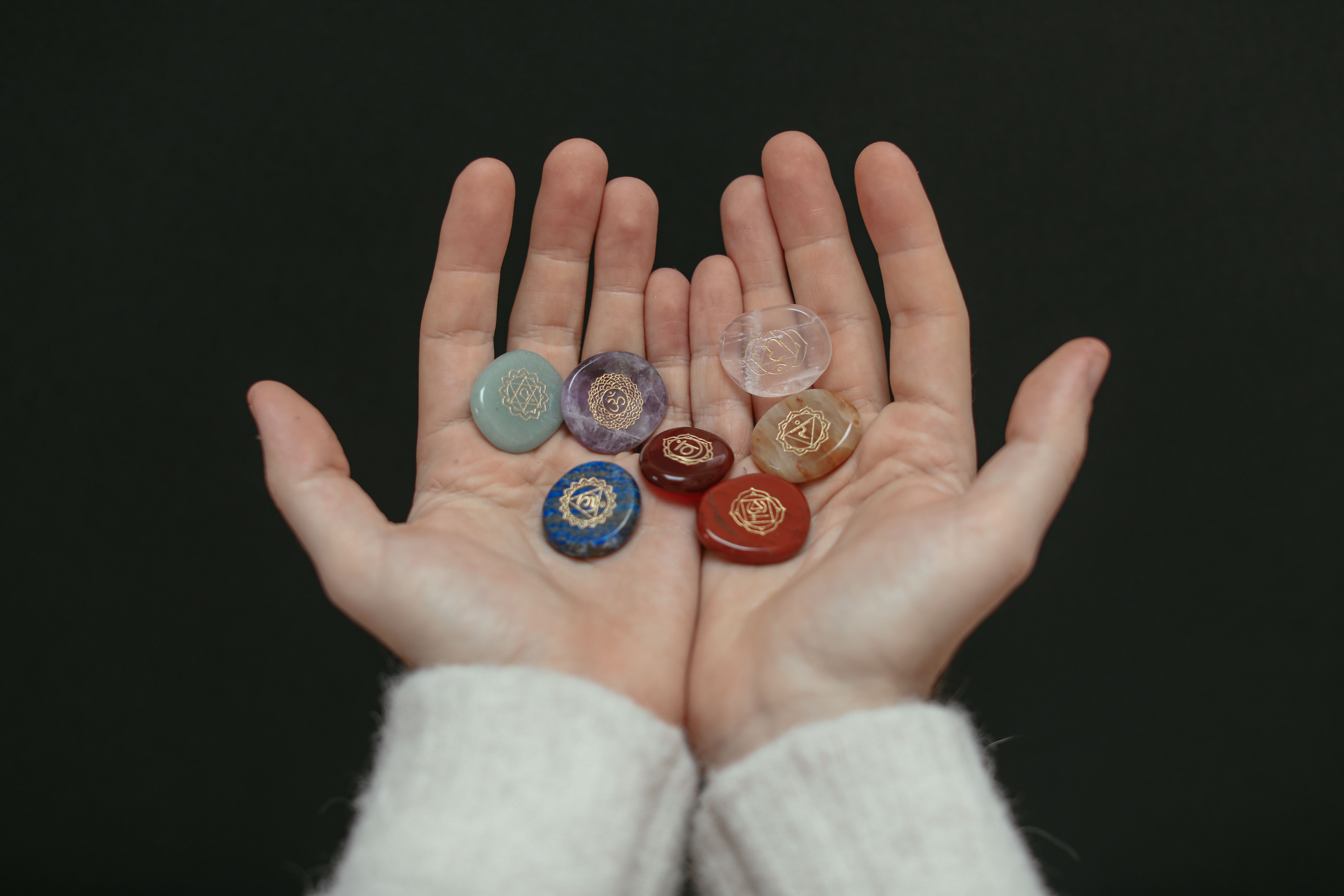
I learnt about chakras in India in 2010. There was a magazine on the bedside table in my hotel in Rishikesh, one of those glossy in-house publications that hotels print to keep guests reading about the things they should do before they leave. I picked it up looking for restaurant recommendations and ended up reading a feature on the seven energy centres of the body. Spinning wheels of colour, the article said. Crown, third eye, throat, heart, solar plexus, sacral, root. The whole thing felt convincing in a way I couldn't articulate, the way a lot of things felt convincing in India.
About a decade later I sat down with a Human Design chart for the first time and recognised the same map. Nine geometric shapes stacked along an implied body, some filled in, some empty. Each one corresponded almost exactly to a chakra I'd already been told about. Crown at the top, throat in the middle, gut at the bottom. Same idea, different drawing.
That recognition is what this post is about. Most people approach chakras and Human Design as two separate systems, often two systems that have nothing to do with each other. They are the same map. The difference is the resolution, and the difference matters more than you might think.
TL;DR
The Human Design bodygraph is a direct evolution of the chakra system. Ra Uru Hu, who synthesised Human Design in 1987, mapped the seven traditional chakras onto a nine-centred bodygraph. The Head and Ajna replace the Crown and Third Eye. The Throat stays as the Throat. The Heart chakra splits into the G Centre (identity, direction) and the Heart/Ego Centre (willpower). The Spleen becomes its own centre, separate from the Root. The Sacral keeps its name. The Solar Plexus keeps its name. The Root stays at the bottom.
The practical difference is that chakra teaching treats all seven as universal. Human Design says some of your centres are consistently energised (defined) and some are not (undefined). Reading the bodygraph tells you which is which. Reading both systems together gives you a framework anchored in centuries of contemplative tradition AND a chart specific to your moment of birth.
What the chakra system claims
Before we get to Human Design, a quick refresher on what the chakras are. The system comes from the Vedic and Tantric traditions of South Asia, with the seven-chakra model most westerners recognise emerging from texts such as the Sat-Cakra-Nirupana, a sixteenth-century Sanskrit work that British orientalist Sir John Woodroffe translated as The Serpent Power in 1919. That translation is the bridge through which the chakra system entered Western consciousness. The word chakra itself means wheel. The teaching is that there are seven major energy centres aligned along the spine, each governing a different aspect of human experience.
The seven, top to bottom:
- Sahasrara, the Crown. Connection to the transcendent. Inspiration. Pressure from above.
- Ajna, the Third Eye. Perception. Concepts. The processing of information.
- Vishuddha, the Throat. Expression. Manifestation through speech.
- Anahata, the Heart. Love. Identity. The bridge between body and spirit.
- Manipura, the Solar Plexus. Personal power. Emotion. Will.
- Svadhisthana, the Sacral. Vitality. Creativity. Sexuality.
- Muladhara, the Root. Survival. Grounding. The base of everything.
Each chakra has a colour, an element, a sound, and a list of physical and emotional issues associated with its imbalance. Yoga magazines have done a lot of marketing for this system, which is why you can probably name the colours faster than you can describe what the chakras do.
The piece nobody mentions in yoga class is that the system was never meant to be diagnostic. It was a contemplative map for practitioners, used inside a much larger framework of breathwork, mantra, and meditation. Pulling chakras out of that context and turning them into a personality system is a Western adaptation. Useful, sometimes accurate, often vague.
What Human Design did with it
Human Design was synthesised by Alan Robert Krakower, who took the name Ra Uru Hu, in Ibiza in 1987. He drew the system from four sources he called the "four pillars": astrology, the I Ching, the Kabbalistic Tree of Life, and the chakra system. The chakras are the bones of the bodygraph. His official organisation, Jovian Archive, still publishes the foundational texts and trains the practitioners who teach the system today.
The piece Ra Uru Hu added (and this is where the system asks for some willingness to suspend disbelief) is a claim that the human chakra system mutated around 1781, the year astronomer William Herschel discovered Uranus. Before 1781 we were "Strategic" beings operating on the seven-centred system. After 1781 we became "Aware" beings operating on a nine-centred system. The mutation, in his framing, isn't metaphor. It's literal.
You don't have to swallow the cosmic mutation story to use the bodygraph. Treat it as origin mythology, the way you treat the seven days of creation in Genesis. The practical output is a chart with nine centres instead of seven, and that practical output is what most people are after.
Here is how the seven became nine.
The actual mapping
The crown chakra split into two. The Head Centre (inverted triangle at the top) handles inspiration and the pressure to know. The Ajna Centre (the upward triangle beneath it) handles processing, concepts, the work of turning inspiration into thought. In chakra terms, these two are the Crown and the Third Eye. Same territory, two distinct centres in the bodygraph.
The throat chakra stayed as the Throat Centre. No split. Communication, expression, and the mechanism that turns thought into action.
The heart chakra split into two. This is the most interesting move Human Design makes. In chakra teaching, the heart governs love, identity, and willpower as one unified experience. The bodygraph splits these into the G Centre (a diamond, sitting just below the throat, governing identity, direction, love, and the sense of self) and the Heart/Ego Centre (a smaller triangle to the right, governing willpower, material drive, and the part of you that makes promises and keeps them).
The split makes sense the moment you've been in love with someone you couldn't make a life with, or willed yourself through a project you no longer cared about. Identity and willpower are not the same engine. The chakra system blurs them. The bodygraph separates them.
The solar plexus chakra stayed as the Solar Plexus Centre. Emotion. The wave that moves through you whether you want it to or not.
The sacral chakra stayed as the Sacral Centre. Life force, vitality, sexual energy, the body's capacity to keep going.
The root chakra split into two. The Spleen Centre (a triangle on the left side) holds intuition, immune function, and the older, quieter survival instincts. The Root Centre (a square at the bottom) holds adrenal pressure, the energy that drives you forward under stress. Chakra teaching folds these together into the Muladhara. The bodygraph pulls them apart.
That's the mapping. Seven chakras, nine centres, with the Heart and Root each splitting into two functional pieces.
Where the systems genuinely differ
The mapping is most of the synthesis. The bit that genuinely differs (and the bit that makes Human Design more useful for self-knowledge) is the concept of definition.
In chakra teaching, you have all seven chakras. The work is to keep them balanced. An "open" or "blocked" chakra is something to fix. The aspiration is harmony across the whole system.
In Human Design, your bodygraph shows you which centres are defined (consistently energised, filled in on the chart) and which are undefined or open (not consistently energised, left unfilled on the chart). This is not a moral judgement. It is not something to fix. It is a description of how your specific energy works.
A defined centre is reliable. Whatever it governs, you carry it consistently. An undefined centre is variable. Whatever it governs, you experience it through the people and environments you spend time with. An undefined Throat means you don't have a fixed voice. An undefined Solar Plexus means you feel other people's emotions more than your own. An undefined Sacral means you can work yourself into exhaustion because you don't have a built-in shutoff signal.
This is the bit that makes the bodygraph useful in a way the chakras alone are not. The chakra system tells you about the territory. The bodygraph tells you which parts of the territory are yours.
Reading both systems at once
If you've been working with chakras for years and you're new to Human Design, the bodygraph gives you a chart-specific overlay on the system you already trust. The vocabulary you've built (root, throat, heart, crown) translates directly. You just have a more specific map of which centres are working for you and which are working through you.
If you've been working with Human Design and you're chakra-curious, the older tradition adds depth the bodygraph cannot. Centuries of meditation practice, breathwork, mantra, and somatic work, all developed around these centres. The chakra teachings on each centre go much further than the Human Design glossary entries.
For anyone approaching both for the first time as a sceptic, here is the angle. You don't have to believe that the chakras are spinning wheels of light or that the bodygraph is a literal mutation of human consciousness in 1781. Both can be treated as structured frameworks for noticing yourself. Both can be tested by reading what they say about you and seeing what holds up.
Cosmicarta runs the bodygraph alongside your astrology and your numerology, calibrated to your exact birth chart. If you have worked with chakras and the language is already familiar, your reading will move faster. The centres you already know are the centres you are reading.
FAQ
Are chakras and Human Design centres the same thing?
Almost. Human Design was developed from the chakra system and uses the same anatomical anchor points, with two key differences. The Heart chakra splits into the G Centre (identity, direction) and the Heart/Ego Centre (willpower). The Root chakra splits into the Spleen Centre (intuition, immune function) and the Root Centre (adrenal pressure). The other five centres map directly across.
Why does Human Design use nine centres instead of seven?
Ra Uru Hu, who synthesised Human Design in 1987, claimed that human consciousness mutated from a seven-centred to a nine-centred system around 1781, the year Uranus was discovered. You do not have to take the mutation story literally to use the bodygraph. The practical result is a system with two more distinct centres than the chakras, splitting the Heart and Root into their component functions.
Can I work with both systems at the same time?
Yes. The chakras give you contemplative depth and a vocabulary built over centuries. Human Design gives you a chart specific to your moment of birth and the concept of defined and undefined centres. Reading them together is closer to how the systems were always meant to work.
Is the bodygraph just a Western rebrand of chakras?
No. Human Design draws on four sources: astrology, the I Ching, the Kabbalistic Tree of Life, and the chakras. The bodygraph is structured around the chakra anchor points but the 64 gates, the 36 channels, and the definition logic come from the I Ching. Calling it a rebrand undersells what it added.
About the author. Tina Benias is the founder of Cosmicarta, a synthesis astrology, Human Design, and numerology platform. She has been studying astrology since 2014, completed her Human Design Living Your Design course in 2022, and has been working with chakra teachings since her first trip to India in 2010. Cosmicarta synthesises all three systems against your exact birth chart.
Read your bodygraph alongside your astrology and numerology at cosmicarta.com/auth. Cosmicarta calibrates all three systems to your exact birth chart, so you can see how your defined centres play with the transits firing in the sky right now. A$13 a month or A$119 a year.
Keep reading
- How to find your Human Design type
- What is astrology
- What is numerology
Sources
- Jovian Archive Media, the official organisation founded by Ra Uru Hu: jovianarchive.com
- Sir John Woodroffe, The Serpent Power (1919), the foundational English-language translation of the Sat-Cakra-Nirupana
- William Herschel's 1781 discovery of Uranus, documented by the Royal Astronomical Society